
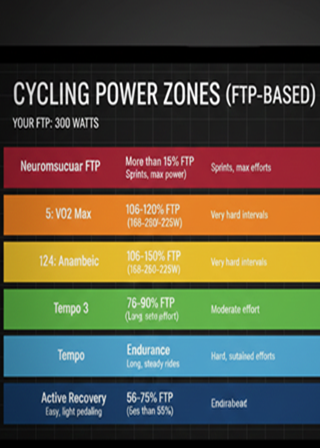

Understanding power zones transforms your cycling training from guesswork into precise, science-based workouts. Once you’ve established your FTP through testing, power zones provide the framework for structured training that optimizes adaptations while managing fatigue and recovery needs throughout your training plan.
Power zones are specific intensity ranges based on your Functional Threshold Power that target distinct physiological adaptations. Each zone stimulates different energy systems. For example, from aerobic base building in Zone 2 to anaerobic capacity development in Zone 6—allowing coaches and athletes to prescribe exact workout intensity for maximum training stress score (TSS) accumulation without overtraining.
The seven-zone model, developed by Dr. Andrew Coggan and Hunter Allen, represents the gold standard for power-based training. This system anchors all zones to your lactate threshold (FTP), providing superior precision compared to heart rate zones, which lag during intervals and fluctuate with hydration, temperature, and cardiac drift over long endurance rides. Training and Racing with a Power Meter by Hunter Allen and Andrew Coggan provides the definitive guide to implementing these seven power zones with detailed protocols for FTP testing, zone-specific workouts, and periodization strategies that transform raw wattage data into breakthrough race performances.
Active recovery rides facilitate blood flow and metabolite clearance without imposing training stress. These easy spinning sessions—typically 30-60 minutes at conversational pace—promote recovery between high-intensity workouts. Your pedal stroke remains smooth, cadence stays 85-95 RPM, and breathing feels comfortable.
Training Purpose: Recovery days, warm-up/cool-down periods, or easy rides following race preparation intervals. Zone 1 doesn’t build fitness but enables training consistency by managing cumulative fatigue during build phases.
Zone 2 represents the foundation of cycling fitness. Approximately 80% of training sessions should occur in Zone 2 for optimal aerobic development. This intensity maximizes mitochondrial biogenesis, enhances fat oxidation, and improves capillary density without excessive glycogen depletion.
Physiological Adaptations: Increased mitochondrial enzyme production, improved lactate clearance, enhanced fuel efficiency. Athletes can sustain Zone 2 for 2-6 hours depending on nutrition strategy and fitness level. Maurten Drink Mix 320 provides 79 grams of carbohydrates per serving using hydrogel technology that enables sustained fueling without gastric distress during extended Zone 2 sessions, allowing athletes to maintain optimal fat oxidation while preventing glycogen depletion on rides exceeding 90 minutes.
Training Applications: Long weekend rides, base training during off-season preparation, volume accumulation for century rides and gran fondo events. Polarized training models emphasize maximal Zone 2 volume combined with limited high-intensity work.
Key Indicator: You should maintain conversation easily throughout Zone 2 efforts. If breathing becomes labored, you’ve drifted into Zone 3 tempo pace.
Tempo represents moderate-hard sustainable intensity—the “grey zone” between comfortable endurance and challenging threshold work. While tempo provides aerobic benefits, it creates more fatigue than Zone 2 while offering less specific adaptations than sweet spot or threshold intervals.
Training Purpose: Transition periods, active rest weeks, or specific race simulation for events requiring sustained moderate effort. Most structured training plans limit Zone 3 to prevent “junk miles” that accumulate fatigue without maximizing adaptation stimulus.
Zone 4 splits into two critical training intensities:
Sweet Spot (88-94% FTP): The most time-efficient training zone, sitting just below threshold. Sweet spot intervals provide 90% of threshold training benefits with significantly less fatigue and faster recovery. Typical workouts include 2×20 minutes or 3×15 minutes with 5-10 minute recovery intervals.
FTP/Threshold (95-105% FTP): Training at or slightly above your critical power increases lactate buffering capacity, raises FTP itself, and improves time trial performance. These demanding intervals—typically 8-20 minutes—require substantial recovery between efforts and 48+ hours before subsequent high-intensity sessions. Thorne Research Creatine provides 5 grams of NSF Certified for Sport creatine monohydrate that accelerates ATP regeneration between threshold intervals, enhances power output during repeated efforts, and reduces recovery time needed between high-intensity training sessions targeting FTP improvements.
Physiological Adaptations: Increased plasma volume, enhanced lactate shuttle mechanisms, improved muscular endurance, elevated mitochondrial density at threshold intensity.
VO2max intervals target your aerobic capacity ceiling—the maximum rate your body can consume oxygen during exercise. These 3-8 minute efforts feel brutally hard, pushing heart rate to 90-95% maximum while creating severe ventilatory stress.
Training Protocol: Classic VO2max workouts include 5×5 minutes or 4×8 minutes with equal recovery time. Smart trainer platforms like Zwift and TrainerRoad excel at maintaining precise power targets during these intervals using ERG mode.
Adaptations: Increased stroke volume, enhanced oxygen delivery, improved neuromuscular recruitment patterns, elevated lactate threshold as secondary benefit.
Timing: VO2max work belongs in build phases 8-12 weeks before priority events, following solid base training foundation.
Short, explosive efforts lasting 30 seconds to 3 minutes that develop anaerobic power for criterium racing, closing gaps, and attacking on climbs. These intervals create significant metabolic stress through glycolytic pathway activation.
Training Examples: 30-second microbursts, 1-minute max efforts, or 2-minute hill repeats with extended recovery (1:3-1:4 work-to-rest ratio).
Maximum power efforts lasting 5-30 seconds that develop sprint performance, explosive acceleration, and neuromuscular coordination. These efforts stress musculoskeletal systems more than metabolic pathways. Nordic Lifting Knee Sleeves provide 7mm neoprene compression and joint stability that protects knees during explosive sprint efforts, reduces injury risk from the high musculoskeletal loads generated in maximal power production, and maintains joint warmth between interval repetitions.
Applications: Sprint intervals, standing starts, jump training for criterium racing and bunch finishes.

If your FTP test resulted in 250 watts, your training zones calculate as:
| Zone | Name | % of FTP | Your Watts | Training Focus |
|---|---|---|---|---|
| 1 | Active Recovery | <55% | <138W | Recovery |
| 2 | Endurance | 55-75% | 138-188W | Base building |
| 3 | Tempo | 76-90% | 190-225W | Aerobic maintenance |
| 4 | Threshold | 91-105% | 228-263W | FTP improvement |
| 5 | VO2max | 106-120% | 265-300W | Aerobic capacity |
| 6 | Anaerobic | 121-150% | 303-375W | Anaerobic power |
| 7 | Sprint | >150% | >375W | Neuromuscular |
Power-to-Weight Context: At 70kg bodyweight, 250W FTP equals 3.57 watts/kg—solid amateur performance suitable for competitive cycling and challenging climbing events.
Modern bike computers from Garmin, Wahoo, and Hammerhead automatically display current power zone during rides when you input your FTP. Training platforms like TrainerRoad adjust entire workout libraries to your tested FTP, ensuring perfect interval intensity across periodized training plans.

The polarized approach advocates 75% of training time in Zone 1-2, minimal Zone 3 (approximately 5%), and 20% in Zones 4-6. This distribution maximizes aerobic adaptations while providing sufficient high-intensity stimulus for performance gains.
Weekly Structure Example (10 hours total):
Alternative models emphasize sweet spot intervals (Zone 4 lower range) for time-crunched athletes. Two weekly sweet spot sessions plus endurance riding provide excellent FTP improvements during 6-8 week base training blocks before transitioning to race-specific intervals.
Off-Season (12-16 weeks): 90% Zone 1-2, building aerobic foundation and training volume tolerance.
Base Phase (8-12 weeks): 80% Zone 2, introduce sweet spot intervals, maintain consistency.
Build Phase (6-8 weeks): Reduced volume, increased intensity with threshold and VO2max workouts targeting race demands.
Peak/Race Phase (2-4 weeks): Maintain intensity, reduce volume, emphasize recovery and race preparation.
Training too much in Zone 3: The “grey zone” accumulates fatigue without maximizing adaptations. Commit to easy Zone 2 or hard Zone 4+ efforts—avoid moderate-hard tempo unless specifically prescribed.
Ignoring normalized power: Variable terrain and group rides create power spikes. Normalized power (NP) accounts for physiological cost of power variability, providing accurate training stress assessment beyond simple average watts.
Neglecting Zone 2 volume: Time-crunched athletes over-emphasize intensity. Base training matters—insufficient aerobic foundation limits high-intensity performance and increases injury risk.
Skipping FTP retests: Training at outdated zones compromises workout effectiveness. Retest every 4-8 weeks during intensive training blocks to maintain zone accuracy.
Should I train at FTP or below it?
Training directly at 100% FTP should be limited to specific threshold intervals lasting 10-20 minutes maximum. Most training occurs in Zone 2 (56-75% FTP) building aerobic base, Zone 3-4 (76-105% FTP) during build phases, and Zone 5+ (106%+ FTP) for VO2max and sprint development. Training constantly at FTP accumulates excessive fatigue without optimal adaptation. Follow 80/20 rule: 80% training time below FTP, 20% at or above threshold.
How do I know if I’m in the right zone?
Power meters provide immediate zone feedback—if prescribed Zone 2, maintain 56-75% FTP regardless of terrain, heart rate, or perceived effort. Heart rate lags power by 30-90 seconds and drifts during long efforts, making it unreliable for real-time zone verification. Learn zone feel through consistent training—Zone 2 allows conversation, Zone 4 permits only short phrases, Zone 5+ prevents talking entirely.
Why does heart rate not match power zones?
Heart rate decouples from power during long efforts due to cardiovascular drift, dehydration, and rising core temperature. At ride start, 200 watts might produce 140 BPM, but after two hours the same power yields 155 BPM. Environmental factors, caffeine, stress, illness, and fatigue also affect heart rate independent of power output. Train by power zones, use heart rate as secondary indicator.
Can I use the same zones for indoor and outdoor training?
Indoor training typically requires reducing outdoor FTP by 5-10% due to heat accumulation, absence of wind cooling, and no freewheeling recovery. Set separate indoor FTP in TrainerRoad, Zwift, or training software. Alternatively, use a fan and accept slightly elevated heart rate and perceived effort at same power outputs. Some athletes maintain identical zones but reduce interval duration indoors.

James Hickman is a former USA Cycling Expert-level coach who has worked with cyclists at every level, from beginners to competitive racers. He served as a coach for the Leukemia & Lymphoma Society’s Team In Training program, helping riders prepare for and complete century events. A Masters-category racer himself, he competed and earned podium finishes in Southern California events and holds a Platinum finish at El Tour de Tucson, completing the century in under five hours.